

Custom Hoodies UK
Hoodie vs Sweatshirt: What’s the Difference and Which Should You Customise?
Apr
When people talk about custom hoodies and sweatshirts, they often use the two terms as if they mean the same thing. They do not. While both garments share the same comfortable, warm qualities, there are meaningful differences in design, function, and how well each one takes a printed or embroidered decoration. If you are choosing between the two for a team uniform, branded merchandise, or a corporate giveaway, understanding those differences will help you make a smarter decision and get a better result.
What Is a Sweatshirt?
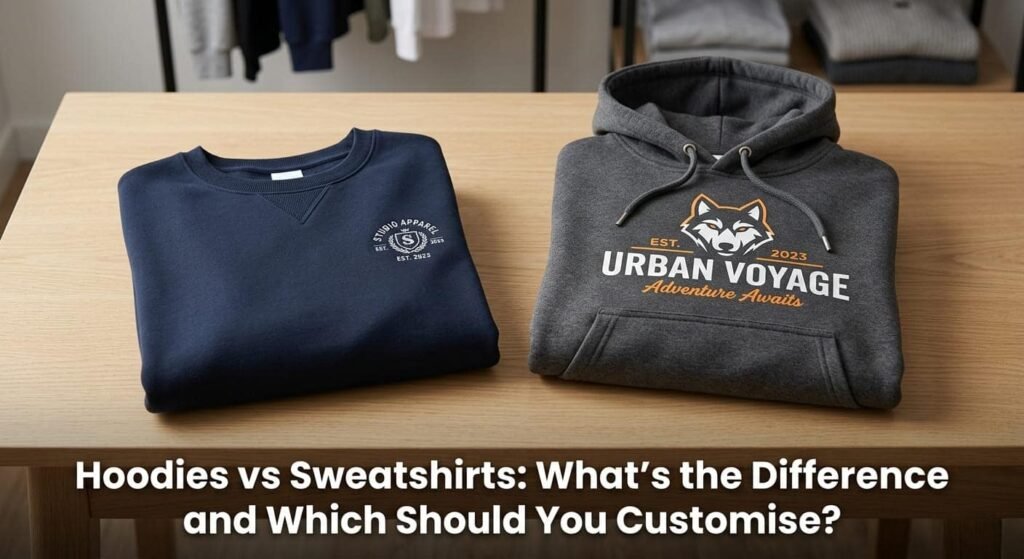
A sweatshirt is a long-sleeved pullover garment, typically featuring a round crewneck neckline, long sleeves hoodie, with ribbed cuffs, and a ribbed hem at the waist. There is no hood, no zipper, and no front pocket. Its defining characteristic is its simplicity, a clean, structured silhouette that sits well on the body and presents a smooth, flat surface.
From a fabric standpoint, custom sweatshirts are usually constructed from cotton fleece, a cotton-polyester blend, or French terry. French terry is a looped fabric on the inside and smooth on the outside. It is lighter than traditional fleece, breathable, and increasingly popular for premium custom apparel. For customisation purposes, fabric weight matters: most quality sweatshirts fall between 280 GSM and 350 GSM, offering enough density to hold both screen-printed ink and embroidery stitching without puckering or distortion.
Historically, the sweatshirt was developed as athletic wear, a practical garment for warmth during training. Today, it sits firmly in the wardrobe as a casual wear staple that crosses into smart-casual territory with ease. It layers cleanly under jackets, photographs well for product shots, and gives embroidered logos a polished, professional finish.
What Is a Hoodie?
A hoodie, short for hooded sweatshirt, is essentially a sweatshirt with one key addition: a hood attached at the neckline, typically with a drawstring to adjust the fit. Most hoodies also feature a kangaroo pocket across the front, and many are available in both pullover and zip-up styles.
The hood itself is what makes this garment distinctive, both functionally and aesthetically. It adds warmth, head coverage in drizzly conditions, and a visual weight to the upper body that defines the streetwear and athleisure silhouette. The zip-up variation adds further versatility, allowing the wearer to regulate temperature easily, a practical advantage for outdoor events, sports teams, or anyone moving between environments.
In terms of fabric, hoodies use the same construction principles as sweatshirts, cotton fleece, cotton-poly blends, or French terry, but tend to sit at slightly heavier weights (300 GSM to 450 GSM) to support the hood structure and maintain shape over time. Heavyweight hoodies, in particular, are strongly preferred for premium embroidery work, as thicker fabric creates a more stable base for dense stitching.
The Key Differences: A Direct Comparison
The core difference between a hoodie and a sweatshirt is the presence of the hood. But when you are deciding on custom apparel, the differences go further than that:
| Feature | Sweatshirt | Hoodie |
| Hood | No | Yes (with drawstring) |
| Front Pocket | No (usually) | Kangaroo pocket (usually) |
| Neckline | Round crewneck | Hooded neckline |
| Style Vibe | Classic, smart-casual | Streetwear, relaxed, casual |
| Print Surface | Larger flat front area | Front and hood panels available |
| Layering | Cleaner under outerwear | Bulkier under jackets |
| Warmth | Warm | Warmer (head and neck covered) |
| Customisation Fit | Ideal for embroidery and chest prints | Ideal for bold graphics and branded drops |
When to Wear Each One
Choose a sweatshirt when you want a cleaner, more refined look. It pairs naturally with chinos, tailored trousers, or even smart denim. For corporate teams, company uniforms, and professional events where the goal is polished yet comfortable, a crewneck sweatshirt is the stronger choice. Its flat front is also the ideal canvas for embroidered logos; the surface is stable, smooth, and the absence of a hood means nothing competes visually with your branding.
Choose a hoodie when warmth, coverage, and casual confidence are the priority. Custom hoodies work exceptionally well for sports teams, university societies, event staff, outdoor activations, and branded merchandise drops. The kangaroo pocket and hood give wearers more ways to interact with the garment, and the bolder silhouette lends itself to larger graphic prints, full-chest designs, all-over patterns, and back prints that all read well on a hoodie.
For mixed audiences, say, a company ordering garments for both an outdoor team-building weekend and an office environment, offering both styles in a coordinated colourway and consistent branding is a smart solution.
Which Should You Customise?
The honest answer is: both are excellent for customisation, but they reward different decoration approaches.
Embroidery works beautifully on both garments. On a sweatshirt, it delivers a clean, corporate-grade finish. On a hoodie, the same embroidered chest logo takes on a slightly more relaxed, premium streetwear character. Embroidery is more durable than print; the design is stitched directly into the fabric, meaning it will not crack, peel, or fade through repeated washing. For workwear, team apparel, and anything that will see heavy use, embroidery is the superior choice. It is worth noting that stitch density matters: for hoodies, a fabric weight of at least 300 GSM is recommended to prevent the stitching from pulling or warping the garment.
Screen printing is the go-to method for bold, multi-colour graphic designs. It produces a vivid, flat finish that is cost-effective for bulk orders. It works well on both cotton and cotton-polyester blend garments. The trade-off is longevity; screen-printed designs can begin to crack or fade after repeated washes if the garment is not cared for properly.
DTG (direct-to-garment) printing is ideal for highly detailed artwork, photographic images, and designs with gradients. It works best on cotton-rich fabrics and delivers a soft, breathable finish. DTG is particularly suited to smaller runs where screen printing’s setup costs are not justified.
DTF (direct-to-film) printing offers versatility across a wider range of fabric types, including polyester-heavy blends, and is increasingly popular for its colour vibrancy and durability.
For design placement, the most effective positions on both garments are the left chest (for logos), the full front panel (for graphics), the back yoke, and the sleeves. Hoods can also be printed or embroidered, though they require specific technical consideration due to the curved surface.
Making the Right Choice for Your Brand
If you are ordering custom garments for a business, team, or event, the most important factors to consider are: purpose, audience, fabric weight, and decoration method. A lightweight French terry sweatshirt embroidered with a discreet chest logo is perfect for a professional services team. A 400 GSM pullover hoodie DTF with a bold graphic is exactly what a streetwear brand or university society needs.
At Forefront Branding, we work with businesses, teams, and organisations across the UK to help them choose the right garment for their brief and decorate it with the right technique for lasting, professional results. Whether you are exploring custom hoodies for a brand launch, custom sweatshirts for a corporate uniform, or both for a seasonal merchandise range, the team at Forefront Branding will guide you through fabric options, decoration methods, and design placement to make sure the final product looks exactly as it should.
Frequently Asked Questions
Q1. What is the main difference between a hoodie and a sweatshirt?
The primary difference is that a hoodie has an attached hood and usually a kangaroo pocket, while a sweatshirt features a plain crewneck neckline with no hood. Both are pullover garments made from similar fleece or cotton-blend fabrics.
Q2. Which is warmer, a hoodie or a sweatshirt?
A hoodie is generally warmer because the hood provides additional coverage for your head and neck. In mild conditions, a sweatshirt offers comparable warmth, but for cold or windy weather, the hoodie has a clear functional advantage.
Q3. Can you embroider a hoodie?
Yes, hoodies can be embroidered effectively. For best results, choose a heavyweight hoodie of at least 300 GSM. The chest, left breast, and sleeve are the most common embroidery locations. Thicker fabric supports denser stitching and prevents puckering or distortion.
Q4. What is better for printing, a hoodie or a sweatshirt?
We accept DTG, DTF, and embroidery well. Sweatshirts offer a larger, flatter print surface ideal for clean logos. Hoodies suit bold graphic designs. Forefront Branding can advise on the best method for your specific design.
Q5. What fabric is best for custom hoodies?
Cotton fleece, French terry, and cotton-polyester blends are the most widely used fabrics. For embroidery, heavyweight fleece (300–400 GSM) gives the cleanest results. For print methods like DTF, cotton-rich blends deliver the sharpest colour reproduction and softest hand feel.
Q6. Is a hoodie smart casual?
A hoodie is generally considered casual rather than smart casual. A plain crewneck sweatshirt in a neutral colour leans toward smart casual and is more appropriate for professional settings such as casual Fridays, client-facing roles, or branded corporate wear.
Q7. What is a zip-up hoodie vs a pullover hoodie?
A zip-up hoodie has a full-length front zip for easy on-and-off wear, while a pullover hoodie is worn over the head with no zip. Both styles are available for customisation with print or embroidery, and both are popular choices for team and branded apparel orders.
